
View Products:

Float and tape systems are among the most proven and dependable level measurement technologies in bulk liquid storage. A buoyant float rides directly on the liquid surface and is connected by a stainless-steel tape or cable to a gauge head at the roof or ground level. As the liquid level changes, the float rises or falls, rotating a precision tape drum and providing a continuous, intuitive mechanical readout without the need for external power. Because the measurement is driven purely by buoyancy and gravity, float and tape gauges remain accurate and consistent even during power outages, harsh weather, or challenging process conditions. This makes a float and tape gauge an essential system for redundant, always visible level indication in line with guidelines from MPMS, API 2350, and other standards.
These systems excel where simplicity, visibility, and reliability matter most. They provide true mechanical indication at the tank, can achieve API-compliant accuracy over long ranges, and can be installed on fixed-roof, floating-roof, cone-roof, or pressurized tanks. Float and tape gauges handle a wide range of products including fuels, chemicals, crude oil, and water, and can use guide wires, stilling pipes, or pan floats to maintain stable operation in turbulence. Installation typically involves mounting the gauge head on a 1½-inch pipe and ensuring straight, vertical travel for the float assembly, with proper alignment and guide support for tanks operating under higher pressure or with internal disturbances.
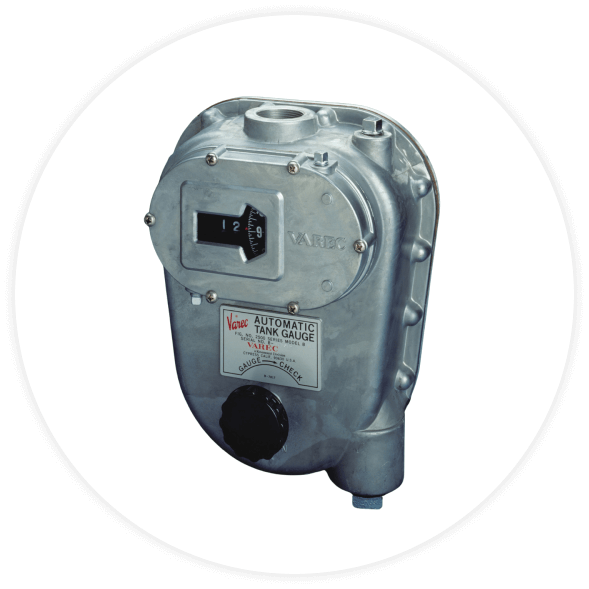
Float and tape systems remain the benchmark for liquid storage tanks, particularly where mechanical reliability, local indication, and simplicity are valued.
Ideal applications include:
Petroleum terminals and refineries – for product storage, blending, and custody transfer verification.
Chemical and petrochemical facilities – where compatibility and corrosion-resistant materials are required.
Water and wastewater treatment plants – for reservoirs and process tanks.
Global custody-transfer standards such as OIML R85, API MPMS and ISO 4266 emphasize continuous verification, traceability, and control of total measurement uncertainty. API MPMS and OIML methodologies for calculating corrected volumes are also built on the principle of cross-checking level, reference height, and tank calibration data. To meet these expectations in real-world tank environments, most operators rely on dual, independent level measurements to validate accuracy and detect drift before it impacts fiscal volumes.
While a single level gauge provides the primary reading, a complementary technology (such as servo + radar or radar + mechanical) creates the independent reference point these standards assume for maintaining certified accuracy classes and proving metrological integrity over time.
In practice, the accuracy and verification framework defined by OIML, ISO 4266, and API MPMS is best satisfied by a redundant level-measurement architecture—one instrument serving as the primary custody device, and a second providing the independent confirmation needed for auditability, traceability, and long-term measurement confidence.
| Technology | Where It Excels | How It Complements Float & Tape |
|---|---|---|
|
Radar (EVO 1610 / EVO 2600 / SFI) |
Non-contact, high-accuracy measurement across vapor, foam, temp. |
Provides continuous electronic verification and redundancy; pairs with float & tape’s mechanical reference for API 2350 safety and audit traceability. |
|
Servo Gauges (MCG 1500SFI) |
Custody transfer accuracy; density and interface measurement. |
Adds precision density/interface data float & tape cannot provide, while float & tape delivers a mechanical fail-safe reference for critical tanks. |
|
Capacitance Level Transmitters |
Compact installations; interface detection; multi-point measurement. |
Adds additional data points (e.g., interface/water bottom) to augment float & tape’s primary product level for a more complete tank profile. |
|
Ultrasonic/Microwave Switches |
Independent alarms; harsh or solids applications; API 2350 layers. |
Supplies independent high/low-level safety trips, complementing float & tape’s continuous mechanical measurement with alarm redundancy. |
|
Float & Tape Transmitters |
Converts mechanical motion into an electrical output such as 4–20 mA, HART, or Modbus. |
Enables remote monitoring and automation while preserving local mechanical indication for safety and power-loss reliability. |
For operators who need both mechanical indication and digital output, transmitters mount directly to the ATG gauge head.