
View Product:

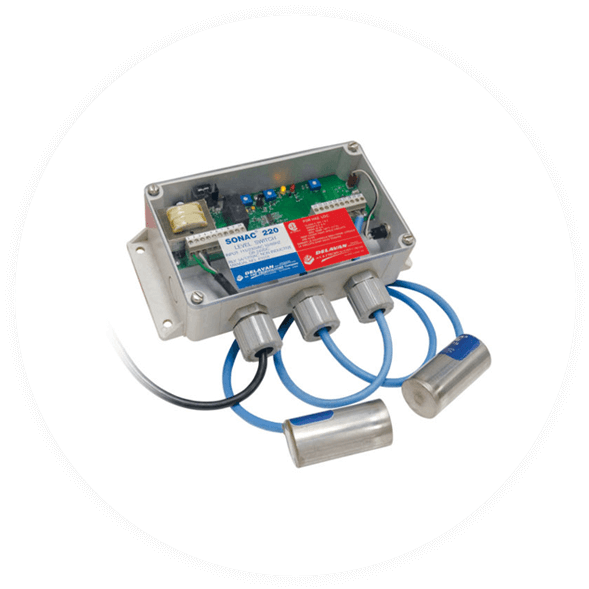
For terminal operators, plant engineers, maintenance teams, and EPC specifiers who need precise high- or low-level alarms or plugged-chute detection in difficult liquids or bulk solids without intrusion into the process.
Choose an ultrasonic switch when you need non-contact, through-air detection in challenging process conditions:
No Contact With Material: Avoids wear, coating, or buildup—ideal for sticky, abrasive, or corrosive solids.
Works in Dusty or Steamy Conditions: Ultrasonic energy is unaffected by opacity or color.
Gentle on Fragile Materials: Detects powders or flakes that could be damaged by mechanical probes.
Handles Very Low Bulk Densities: Reliably senses materials as light as ¼ lb/ft³.
Fail-Safe and Self-Checking: Internal self-test ensures proper operation and alarms on any component failure.
Simple Setup and Calibration: Adjustable delays (50 ms–30 s) and field-selectable fail-safe logic.
| Attribute | Sonac 110 (Magnetostrictive Liquid Switch) | Sonac 220 (Ultrasonic Bulk/Solids Switch) | Microwave 320 (Non-Contact Microwave Switch) |
|---|---|---|---|
|
Measurement Principle |
Magnetostrictive resonant damping sensor with diaphragm and pickup coil |
Ultrasonic acoustic feedback between matched transmitter/receiver sensors (≈38 kHz) |
Pulsed X-band microwave (10.525 GHz) transmitter/receiver pair with pulse discrimination |
|
Type |
Contact |
Contact (non-intrusive for solids; sensors face each other) |
Non-contact |
|
Primary Media |
Liquids only (crude, refined products, solvents) |
Solids, granular materials, fragile products, opaque or transparent objects (≥¼ lb/ft³) |
Liquids or solids; detects through non-metallic windows; requires window for metal tanks |
|
Typical Applications |
Overflow alarm, high/low liquid level, small vessels/pipes |
Bulk solids level, position detection, plugged chute, fragile materials |
External level detection, aggressive/hot products, bins/chutes/tanks |
|
Fail-Safe Capability |
Self-testing circuit triggers relay on failure |
Internal self-test (new PCB) |
Selectable fail-safe (high/low) |
|
Operating Temp – Electronics |
-40 to 160 °F |
Nylon sensor: 220 °F; Ryton: 400 °F |
–40 to 160 °F |
|
Operating Temp – Sensor/Process |
Liquid-contact diaphragm; temp defined by sensor build |
Up to 400 °F for Ryton sensor |
Up to 750 °F with high-temperature weldments/sensors |
|
Pressure Rating |
Up to 2,000 psig maximum |
Not pressure-rated (ambient solids/air-gap use) |
Weldment/window dependent; microwave head itself not pressure-rated |
|
Output Type |
SPDT relay |
Relay output |
DPDT relay (5 A @120 VAC; 3 A @240 VAC/24 VDC) |
|
Power Requirements |
4-wire electronic switch |
AC/DC depending on configuration |
115 VAC, 24 VDC, or 230 VAC; 6 VA |
|
Intrusion Into Process |
Minimal (<¼″ probe tip) |
Non-intrusive to solids (air-gap) |
No intrusion |
|
Calibration |
Gain + time delay adjustments |
Gain + strap adjustments |
Gain, time delay, gain select |
|
Signal Path Sensitivities |
Damped by liquid contact |
Affected by humidity/temperature (auto-adjust frequency) |
Response varies with dielectric constant & conductivity |
|
Maintenance |
No moving parts; periodic function check |
Clean sensors; verify alignment |
Align windows; keep path clear |
|
Not Recommended For |
Solids, powders, aerated slurries |
Heavy slurries/high-viscosity liquids |
Direct immersion in liquids |
Use the Sonac 220 instead of another L&J switch when you need: