
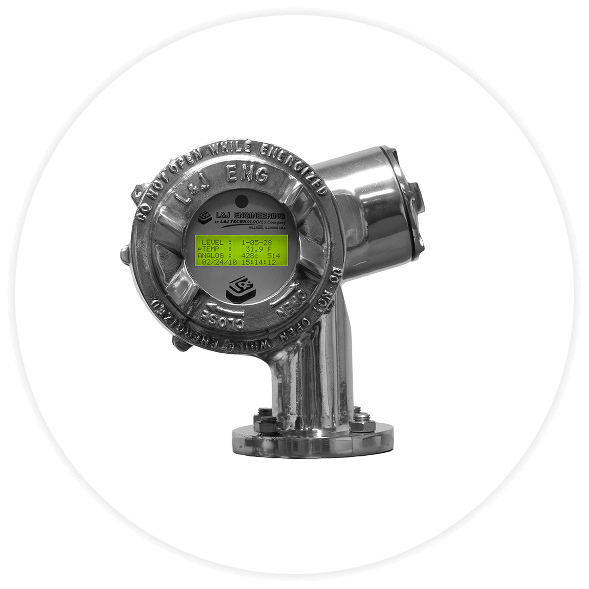
Servo Level Gauge

View Product:

Servo Level Measurement: Trusted Accuracy for Product, Interface & Density

Servo level gauges are highly precise contact instruments that physically interact with the liquid in a tank to determine level, interface, and density using buoyancy and finely controlled mechanical movement. A small displacer is lowered into the tank on a stainless-steel cable; as the displacer transitions between air, product, or water, its apparent weight changes according to Archimedes’ principle. The servo gauge continuously senses this change and automatically positions the displacer at the liquid surface, providing an exceptionally accurate measurement of product level, water bottom, and density.
Because servo gauges rely on buoyancy—not dielectric contrast or vapor conditions—they excel where non-contact technologies can struggle: heavy foam, emulsions, very low dielectric hydrocarbons, turbulent surfaces, and pressurized vessels. They are also ideal for interface detection when two liquids differ in density. Facilities that require dependable custody-transfer accuracy, high-pressure operation, or proven mechanical principles continue to rely on servo systems across refineries, tank farms, and petrochemical plants.
Installation typically involves mounting the gauge on a stilling well or process nozzle, ensuring clear vertical travel for the displacer and selecting a displacer sized for the expected density range. Proper mechanical alignment and periodic inspection ensure long-term performance.
Cognesense’s servo gauge system sets the benchmark for modern servo gauging, combining a rugged mechanical design with advanced electronics. With ±0.4 mm accuracy and only three moving parts, the gauge uses a magnetic coupling to isolate the measuring chamber from the electronics and a precision strain-gauge system to detect displacer force changes with high sensitivity (±0.1 mm resolution). The Intelligent Scale Board refines measurements digitally and allows full calibration through an infrared handheld device—without opening the explosion-proof housing, even in hazardous areas. Built for longevity and easy integration into legacy plant systems, it handles high-temperature and high-pressure applications, offers a broad selection of protocols, and supports density, BS&W, and temperature measurements from a single device. This makes Cognesense’s servo gauges the preferred choice for operators who require accuracy, reliability, and complete tank data in the most challenging environments.

Why Use a Servo Gauge

Servo gauges represent the highest-accuracy level-measurement technology available, and at Cognesense they are our flagship custody-transfer instruments. They are selected when operations demand traceable mechanical accuracy, direct physical reference to the liquid surface, and fully auditable measurements for custody transfer, inventory control, loss management, and metrology compliance.
Unlike radar or other inferred-signal technologies, servo gauges provide a true mechanical reference using a precision displacer suspended on a measuring wire. The gauge’s servo motor continuously balances the displacer’s buoyant force against its own reference weight—detecting micrometric changes that correspond to product level, density, and interface position.
Cognesense’s servo gauges such as the MCG 1500SFI deliver custody-grade ±0.4 mm accuracy, ±0.1 mm sensitivity, and long-term stability regardless of vapor space, dielectric constant, product type, or tank conditions. This makes them the preferred choice for fiscal and legal-metrology applications across crude oil, refined fuels, petrochemicals, chemicals, and other multi-phase products.
And unlike competitive servo gauges, L&J/Cognesense designs are engineered for the real-world demands of terminals and refineries, offering:

These capabilities dramatically reduce operating costs, minimize downtime, and enhance safety while maintaining the highest accuracy standard in the industry.

Applications and Use Cases

Servo level gauges are best suited for applications where traceability, metrological integrity, and auditability are essential, such as:

Custody transfer storage tanks where legal metrology or fiscal measurement is required.

Petroleum and chemical terminals handling refined products, crude oil, or additives.
High-pressure / LPG / LNG service where radar signal penetration is limited.
Density, interface & BS&W (bottom sediment & water) measurements of density and product/water interfaces – critical for proving quality and settlement.
Process tanks requiring integrated temperature and pressure compensation for precise mass balance.

Refineries, tank farms, and blending operations where inventory and loss control depend on certified accuracy.

MCG 1500SFI Shown with WirelessHART

MCG 1500SFI

Terminal operations managers, tank farm automation engineers, custody transfer & compliance officers, and EPCs need ultra-accurate..

How Other Level Technologies Complement Servo Gauges

International custody-transfer standards, including OIML R85, ISO 4266, and API MPMS, emphasize traceability, redundancy, and independent verification to maintain certified accuracy classes. These standards assume that operators will cross-check primary level readings with an independent secondary measurement to ensure long-term stability and detect drift before it impacts fiscal calculations.
To meet these expectations in real-world tank environments, most operators rely on dual, independent level measurements to validate accuracy and detect drift before it impacts fiscal volumes.
While a single level gauge provides the primary reading, a complementary technology (such as servo + radar or servo+ mechanical) creates the independent reference point these standards assume for maintaining certified accuracy classes and proving metrological integrity over time.
In practice, the accuracy and verification framework defined by OIML, ISO 4266, and API MPMS is best satisfied by a redundant level-measurement architecture with one instrument serving as the primary custody device, and a second providing the independent confirmation needed for auditability, traceability, and long-term measurement confidence. Under real world conditions, a servo + secondary technology architecture delivers the most robust metrological assurance:
Technology Where It Shines How It Complements Servo Gauges
FMCW Radar (evo 2600)
Non-contact, maintenance-free measurement
Radar complements servo gauges by providing redundant or secondary level data in tanks where servo gauges are used for custody transfer or interface/density readings. Ideal for combining continuous non-contact measurement with servo’s traceable reference.
Float & Tape / Gauge Boards (Varec 2500, L&J 92021)
Simple, mechanical visual indication without power.
Float and tape systems complement servo gauges by offering mechanical redundancy in case of power loss and visual confirmation for API 3.1A compliance or manual verification of level during calibration or maintenance.
Capacitance Level Transmitters (Cap Analog 400 Series)
Compact, accurate probes suited for small, pressurized, or underground tanks.
Capacitance technologies complement servo gauges by providing local or redundant readings in small or auxiliary tanks. They also supply interface or water-bottom data to validate servo density readings.
Magnetostrictive/ Ultrasonic / Microwave Switches (Sonac 110, Sonac 220, Microwave 320)
Reliable high- or low-level point detection in liquid or solid applications.
Switch technologies complement servo gauges by delivering independent alarm or safety shutoff signals that create an API 2350-compliant protection layer beyond continuous level measurement.
Float-Type Displacer Switches (Omnitrol)
Rugged mechanical control for alarms in high-temperature or pressure service.
Omnitrol displacer switches complement servo gauges by providing mechanical alarm actuation for redundancy and safety in overfill, low-level, or density-control systems.
Together, these technologies form a multi-layered measurement ecosystem—but the servo gauge remains the primary reference standard for custody-grade accuracy.

Why Servo Gauges Remain the Reference Standard

Servo gauges are recognized globally as the benchmark technology for legal custody transfer because they provide:

When paired with radar, magnetostrictive probes, or mechanical switches, servo gauges anchor the system with the highest traceable accuracy while complementary technologies provide redundancy, alarm functions, or continuous verification.

Summary

Servo gauges remain the gold standard for custody transfer, density measurement, and interface detection, delivering unmatched ±0.4 mm accuracy and mechanical traceability. But Cognesense servo gauges go further by offering in-field repairs, in-field upgrades, and remote IR calibration that dramatically reduce lifecycle cost and increase safety during operation.

While radar, capacitance, and mechanical switches each contribute unique strengths, the servo gauge is the central reference point in any high-performance metrological architecture. Only Cognesense provides a fully integrated portfolio including servo, radar, magnetostrictive, mechanical level gauging, plus switches, all designed to work together seamlessly, giving operators the most complete, accurate, and redundant tank measurement ecosystem in the industry.