
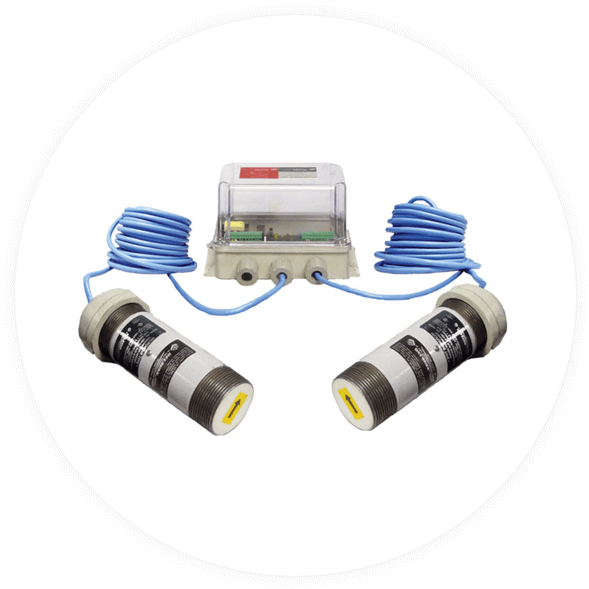

Microwave 320 — Non-Contact Microwave Level & Position Switch

Overview

Microwave 320

Process engineers, plant operators, EPC designers, and maintenance teams need reliable point-level or object detection in harsh, dusty, corrosive, or high-temperature environments. For them, the Microwave 320 provides non-contact microwave sensing that detects liquid or solid presence without touching the process media.

Unlike capacitive, ultrasonic, or photoelectric switches — and unlike Sonac 110/220 contact-type switches — the Microwave 320 is immune to dust, vapor, coating, vibration, and buildup and can be mounted externally through a sightglass or non-metallic wall. It’s ideal for abrasive materials, corrosive chemicals, high-temperature ducts, and plugged-chute detection where contact-based devices fail.

Choose the Microwave 320 when contact is impossible or undesirable, extreme environments exist, or long-term reliability without maintenance is critical.

Features

Non-Contact Technology

Non-Contact Microwave Technology

Senses material presence without contacting product — no buildup, wear, or corrosion.

Sees Through Non-Metallic Walls/Sightglass

Enables external installation on pressurized or corrosive vessels without penetrations.

Immune To Dust, Fog, Vapor & Vibration

Maintains reliable switching in cement, grain, mining, and chemical vapor environments.

Wide Temperature Range

High-Temperature Capability

Optional water-cooled MT/MR sensor heads support extreme heat applications.

Pulse-Coded Transmission

Rejects electrical & microwave interference — avoids false trips.

Adjustable ON/OFF Delay

Prevents nuisance chatter in turbulent or intermittent flows.

Rugged Brushless Design

Rugged Corrosion-Resistant Enclosure

Glass-reinforced polyester housing for chemical and outdoor duty.

No Moving Parts

No Moving Parts

Zero mechanical wear — maintenance-free operation.

Details

The Microwave 320 is engineered for environments where traditional level switches fail:

A directional microwave beam detects material movement or presence — whether inside a vessel, through a process window, or across a chute — ensuring accurate high/low alarms, blockage alerts, and feed control. With no wetted parts, it performs reliably even where product buildup, abrasion, or corrosion would destroy conventional switches.

Applications

Technical Specifications

Parameter Value
Technology
Non-contact microwave (X-band 10.525 GHz)
Media
Liquids, solids, slurries — presence/absence
Output
SPDT relay
Action
ON/OFF switching
Range
Several-foot air gap (application dependent)
Beam Angle
~40°
Power
120 VAC / 240 VAC / 24 VDC
Housing
Glass-reinforced polyester, sealed industrial
Temperature
High-temp option with water-cooled MT/MR assemblies
Environment Resilience
Immune to dust, fog, vapor, vibration
Adjustments
Independent ON & OFF time delay
Approvals
FM Approved (with MT 851 / MR 851 heads)
Mounting
External through sightglass or wall; bracket mounting

Documents and Downloads

Product Flyer

Have a look at the flyer to get all the tech specs and product features. Brochure

User Manual

Read the manual for detailed information and instructions. Manual

Calibrations

Check out a sample cert from our calibration lab. Certificate

Contact Support

If you have a question that we have not covered then just get in touch and we’ll be happy to help.

FAQs

We have tried to answer the most common questions we are asked here.

Microwave sensing is unaffected by buildup, dust, fog, and vibration — making it far more reliable in rugged industrial environments.

Yes — it excels in solids applications like grains, powders, pellets, cement, and mining materials.

No. It provides true non-contact detection, ideal for corrosive, abrasive, or sanitary processes.

Yes — microwave waves transmit through non-metallic walls or sightglass, eliminating process penetration.

For extreme heat applications (500°F or higher), the Microwave 320 offers optional water-cooled sensor assemblies. This accessory isolates the electronics from the process heat, ensuring the sensitive components remain within their operating temperature range for safe, stable, and long-term performance.