
View Product:

Because the sensors do not touch the process, microwave switches excel in applications that involve extreme temperatures, corrosive or abrasive materials, heavy buildup, or high-velocity flow—conditions that often damage or overwhelm mechanical point switches. They work through non-metallic tank walls or dedicated microwave windows, and are especially useful in bins, hoppers, chutes, and vessels where solids or sticky products make other technologies unreliable.
Installation Is Straightforward: Mount the transmitter and receiver on opposite sides of the vessel, align their beams, and connect the control unit. With adjustable gain, selectable fail-safe modes, and flexible time-delay settings, microwave switches can be tuned precisely to the process. Once set up, they require minimal maintenance and remain stable over long operating periods.
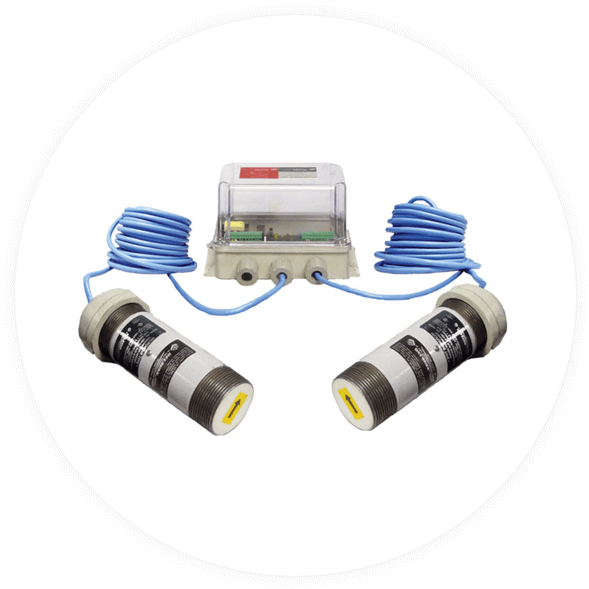
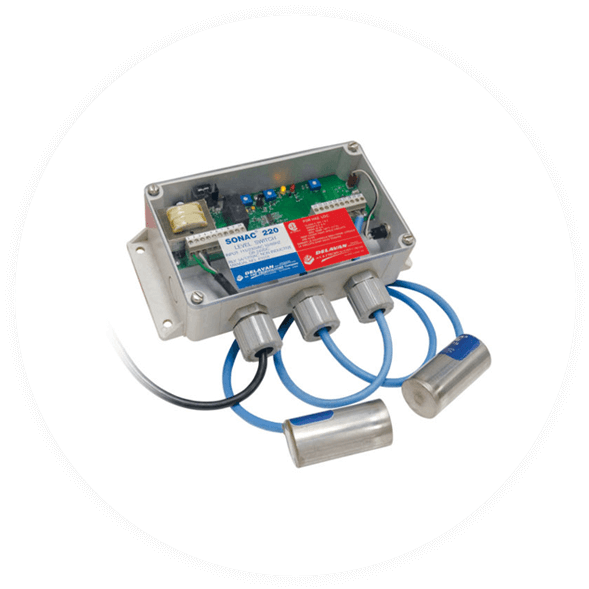
Choose the Microwave 320 for harsh solids or liquid applications with dust, vapor, foam, buildup, or turbulence where reliable point-level detection is critical.
You need non-contact detection across a gap. A transmitter and receiver face each other across a chute, belt, or outlet. No probe in the material stream.
Dust/steam/abrasion/high heat are present. Microwaves penetrate dust and vapor; with windows/waveguides (and optional cooling) the hardware stays protected.
You must avoid vessel penetration. Install behind glass/ceramic/PTFE windows to keep hygiene and pressure boundaries intact.
Simple, robust control is preferred. Binary relay outputs with selectable fail-safe and on/off delays; long cable runs are straightforward.
| Attribute | Sonac 110 (Magnetostrictive Liquid Switch) | Sonac 220 (Ultrasonic Bulk/Solids Switch) | Microwave 320 (Non-Contact Microwave Switch) |
|---|---|---|---|
|
Measurement Principle |
Magnetostrictive resonant damping sensor with diaphragm and pickup coil |
Ultrasonic acoustic feedback between matched transmitter/receiver sensors (≈38 kHz) |
Pulsed X-band microwave (10.525 GHz) transmitter/receiver pair with pulse discrimination |
|
Type |
Contact |
Contact (non-intrusive for solids; sensors face each other) |
Non-contact |
|
Primary Media |
Liquids only (crude, refined products, solvents) |
Solids, granular materials, fragile products, opaque or transparent objects (≥¼ lb/ft³) |
Liquids or solids; detects through non-metallic windows; requires window for metal tanks |
|
Typical Applications |
Overflow alarm, high/low liquid level, small vessels/pipes |
Bulk solids level, position detection, plugged chute, fragile materials |
External level detection, aggressive/hot products, bins/chutes/tanks |
|
Fail-Safe Capability |
Self-testing circuit triggers relay on failure |
Internal self-test (new PCB) |
Selectable fail-safe (high/low) |
|
Operating Temp – Electronics |
-40 to 160 °F |
Nylon sensor: 220 °F; Ryton: 400 °F |
–40 to 160 °F |
|
Operating Temp – Sensor/Process |
Liquid-contact diaphragm; temp defined by sensor build |
Up to 400 °F for Ryton sensor |
Up to 750 °F with high-temperature weldments/sensors |
|
Pressure Rating |
Up to 2,000 psig maximum |
Not pressure-rated (ambient solids/air-gap use) |
Weldment/window dependent; microwave head itself not pressure-rated |
|
Output Type |
SPDT relay |
Relay output |
DPDT relay (5 A @120 VAC; 3 A @240 VAC/24 VDC) |
|
Power Requirements |
4-wire electronic switch |
AC/DC depending on configuration |
115 VAC, 24 VDC, or 230 VAC; 6 VA |
|
Intrusion Into Process |
Minimal (<¼″ probe tip) |
Non-intrusive to solids (air-gap) |
No intrusion |
|
Calibration |
Gain + time delay adjustments |
Gain + strap adjustments |
Gain, time delay, gain select |
|
Signal Path Sensitivities |
Damped by liquid contact |
Affected by humidity/temperature (auto-adjust frequency) |
Response varies with dielectric constant & conductivity |
|
Maintenance |
No moving parts; periodic function check |
Clean sensors; verify alignment |
Align windows; keep path clear |
|
Not Recommended For |
Solids, powders, aerated slurries |
Heavy slurries/high-viscosity liquids |
Direct immersion in liquids |
Yes: a switch is right.
Yes: Microwave 320 with window/waveguide; add cooling if needed.
Use a level gauge (radar/ultrasonic/hydrostatic) or add a small I/O module for comms.
Consider a probe-style switch when a Tx/Rx pair won’t fit.
Microwave 320 focuses on rugged detection with relay outputs. If you need plant-wide comms, either add a small I/O module at the panel or evaluate feature-rich barrier systems.