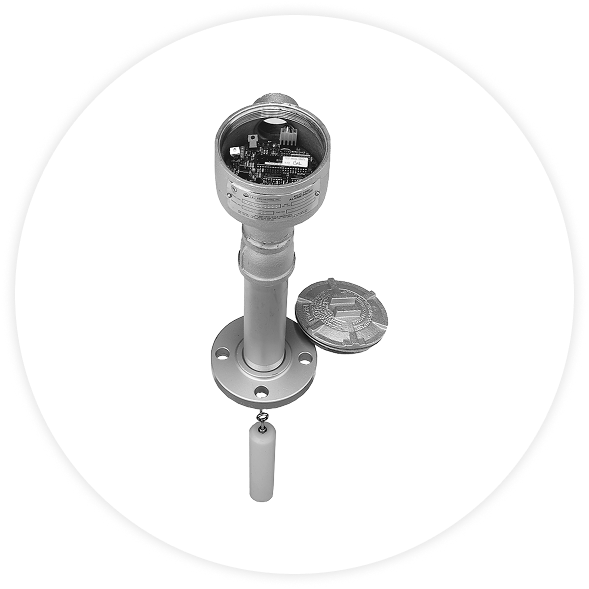
MCG 1090 — Level Alarm Probe

Overview

MCG 1090

For operators who need to ensure reliable overfill prevention and compliance in hazardous environments, the MCG 1090 Level Alarm Probe provides a proven and safe solution. Unlike probes that only simulate a test, the MCG 1090 features a true self-test that physically moves the displacer to verify functionality. This, combined with its remote monitoring and flexible wiring options, makes it easy to integrate and maintain, guaranteeing that the alarm will work when it’s needed most.

MCG 1090

Features

True Self-Test Functionality

The probe physically moves the displacer to test the alarm's full functionality, providing a higher degree of confidence than simple electronic signal checks.

Remote Monitoring

Allows for self-testing to be initiated from the control room or tank-side, reducing the need for manual, in-person checks and improving safety.

Enhanced Safety

Meets state fire codes for independent alarms and holds UL and ATEX explosion-proof certifications for safe use in hazardous areas.

System Flexibility

Can operate as a standalone unit or be multiplexed with up to 128 probes using the MCG 7030 Touch Panel Alarm Monitor, which significantly reduces wiring and installation costs.

Durable Construction

Built with a 304 stainless steel housing and simplified mechanics for long-term reliability and minimal maintenance.

MCG 1090

Details

Applications

The MCG 1090 is a critical safety device for a range of applications:

Technical Specifications

Table Header Table Header
Mounting Connection
1.5-inch or 2-inch NPT; 2-, 4-, 6-inch flange options
Alarms
Hi, Hi-Hi, Lo
Self-Testing
Automatic (via Tankway), Manual (24VDC), or None
Construction
304 stainless steel housing (standard), nylon displacer
Approvals
UL Explosion Proof, ATEX II 1/2 G EEx d IIB T6

Documents and Downloads

Product Flyer

Have a look at the flyer to get all the tech specs and product features. Brochure

User Manual

Read the manual for detailed information and instructions. Manual

Calibrations

Check out a sample cert from our calibration lab. Certificate

Contact Support

If you have a question that we have not covered then just get in touch and we’ll be happy to help.

FAQs

We have tried to answer the most common questions we are asked here.

True self-testing, which physically moves the displacer, confirms that all mechanical and electrical components of the probe are working correctly. This is different from a simple electronic signal check, which may not detect a mechanical fault. This physical verification provides peace of mind that the probe will function properly when an overfill condition occurs.

Yes. While the MCG 1090 can be used as a standalone device, it is also designed to be part of a larger, multiplexed system. Using the MCG 7030 Touch Panel Alarm Monitor, you can connect and monitor up to 128 probes, which centralizes control and significantly reduces the amount of wiring required.

A displacer is a weighted component within the probe that is buoyed by the liquid it is immersed in. When the liquid level rises or falls to a preset point, the displacer’s position changes, triggering a switch inside the probe that activates the alarm. The MCG 1090’s self-test function physically moves this displacer to ensure the entire mechanism is operational.