
Level Alarm Probe

View Products:

Reliable, Self-Testing Overfill and Safety Protection for Storage Tanks

Level alarm probes provide a dedicated, independent layer of protection for overfill prevention, high-level warning, and safety shutdown. Unlike continuous level gauges, these devices are designed to trip at a precise point, thus alerting operators or control systems the moment a tank reaches a critical level. Cognesense alarm probes use a simple but highly robust displacer mechanism: as liquid rises, it lifts a suspended displacer, which reduces the load on a spring-loaded magnetic shaft. When the shaft rises to its trip point, it actuates built-in reed switches to signal High or High-High level conditions. Because the sensing principle is purely mechanical, the alarm point remains dependable even under changing product conditions, vapors, foam, or turbulence.
Modern level probes include optional self-testing circuitry that momentarily energizes an internal solenoid to raise the magnetic shaft—verifying both the mechanical movement and the electronic switch response. Operators can trigger the test locally with a pushbutton, and when used with Cognesense wireless tank monitoring systems, automatic scheduled tests can also be initiated from the control room. This capability provides confidence in safety-critical operation and supports API 2350 and plant safety procedures.

Installation Is Straightforward. The alarm probes mount on the tank roof using a flanged or threaded connection, provided the mounting surface is level and clear of internal obstructions. Dual-displacer versions can provide staged alarms or floating-roof monitoring. The housings are built for hazardous locations, with explosion-proof construction, sealed electronics, and corrosion-resistant materials suitable for harsh tank farm environments. Wireless models use a long-range, frequency-hopping 2.4 GHz link to reach a base station, eliminating the need for conduit runs and simplifying upgrades on older tanks.

Cognesense level alarm probes combine rugged mechanical reliability with smart diagnostics, long-life battery operation, and seamless integration with Cognesense tank monitors. For operators who need proven, low-maintenance, independent safety instrumentation, these probes deliver unmatched assurance that critical high-level alarms will work exactly when needed.
EVO 2600

When to Use a Level Alarm Probe

A level alarm is used whenever it’s critical to detect and alert when liquid levels reach a defined high or low point inside a storage or process tank.
Unlike continuous gauges that track level trends, level alarms act as independent point-level safety devices—providing an immediate warning or triggering automatic shutdown before a tank overfills, runs dry, or exceeds its operating limits.

Level alarms are essential in:

Applications and Use Cases

Level alarms are typically installed on:
Petroleum and chemical storage tanks – to meet overfill safety codes (API 2350, NFPA 30, state fire codes)

Refineries, terminals, and depots – for high-level and high-high alarm redundancy

Power generation, water/wastewater, and food plants – for pump control or sump level alarms

Remote or unattended sites – where wireless models simplify installation and maintenance

L&J’s MCG 1090 (wired) and MCG 1095 (wireless) displacer-type level alarms provide Hi, Hi-Hi, and Low level point detection in virtually any liquid service, including hazardous and flammable products.

Both models use mechanically simple displacer actuation with an optional self-testing solenoid that physically moves the displacer to verify complete mechanical and electronic operation—ensuring full functionality without removing the device from service.
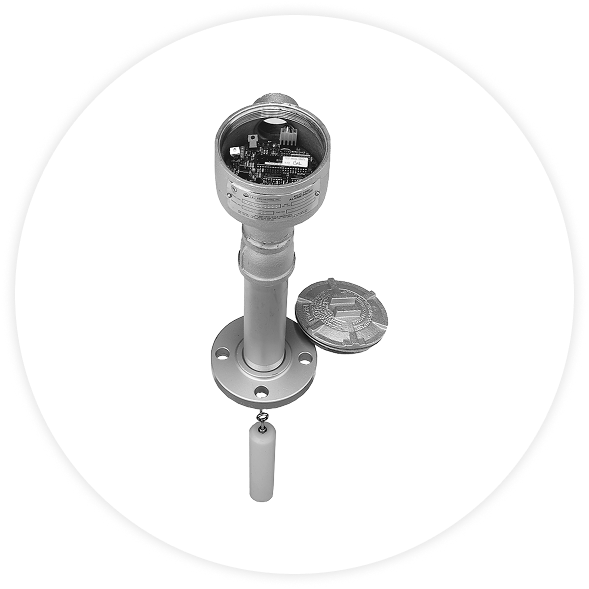
MCG 1090

MCG 1090

The MCG 1090 is a hardwired level alarm providing proven protection via its self-testing design, remote monitoring capability, and flexible wiring options make it easy to integrate into new or existing systems.
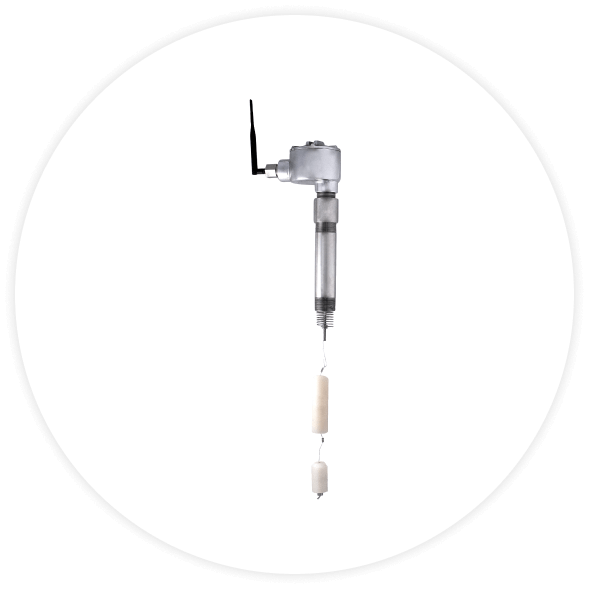
MCG 1095

The MCG 1095 is a wireless level alarm providing reliable overfill prevention with its self-testing design, remote self-checking, and wireless capabilities.

Why Use a Level Alarm in Combination with Another Technology

Purpose Level Alarm (MCG 1090 / 1095) Continuous Level Gauge (Radar, Servo, Float-&-Tape, etc.)
Function
Provides discrete alarm points (e.g., Hi/Hi-Hi/Lo)
Provides continuous measurement of tank level
Response
Immediate trip signal to prevent overfill or dry run
Proportional signal for inventory or control
Compliance
Meets API 2350, IEC 61511, and NFPA 30 overfill protection layers
Supports inventory and custody-transfer accuracy
Redundancy
Acts as an independent protection layer separate from the main gauge
Part of main gauging/control loop
Maintenance
Simple, low-power or battery-powered, no calibration drift
Requires periodic calibration or configuration
Installation
Compact top-mounted or flanged chamber mount
Larger process connections and cabling

In Short

Use level alarms when you need safety, redundancy, or on/off control on your tank in combination with gauges or transmitters that give you continuous level data for inventory or process optimization.
Most tank farms deploy both—a continuous gauge for measurement and an independent level alarm for overfill prevention.

Summary

L&J Technologies’ MCG 1090 and MCG 1095 Level Alarm Probes provide fail-safe, self-testing overfill protection that exceeds API 2350 and global overfill prevention standards.

Use a switch when you only need to detect presence or absence—for example:
Both deliver the same core benefits:

Together, they form the first line of defense in a complete tank safety system—complementing L&J’s radar, servo, and float-and-tape gauges to achieve zero overfill incidents and maximum operational uptime.