

Capacitance level measurement is one of the most proven technologies for detecting liquid and bulk-solid levels in demanding industrial environments. A capacitance system consists of a sensing probe and electronics that energize the probe with a radio-frequency signal. As material rises or falls in the vessel, the dielectric constant between the probe and the tank wall changes—altering the probe’s capacitance. The electronics interpret this change and convert it into either a continuous analog output or a discrete on/off level signal for alarms and pump control. This simple physical principle makes the technology extremely adaptable: it works across liquids, slurries, powders, granular solids, and many low-conductivity materials that challenge other instruments. Built-in coating tolerance technology, guard-electrode designs, selectable gain, and non-interacting adjustments help eliminate false trips caused by buildup or agitation, while fail-safe relays and self-diagnostics support safety-critical applications.
Proper Installation Is Straightforward: Metallic vessels naturally supply the required ground reference, while non-metallic tanks use concentric or dual-probe assemblies to create a stable measurement path. Ensuring good grounding, positioning probes away from nozzles that might trap products, and selecting appropriate insulation materials are the primary considerations for best performance. Once installed and calibrated, capacitance devices respond rapidly, tolerate extreme temperatures and pressures, and require minimal maintenance because they have no moving parts.
Cognesense’s capacitance portfolio offers a complete range of continuous transmitters and point switches engineered for real-world conditions across oil and gas, chemical processing, food and beverage, water treatment, and bulk-solid handling. With explosion-proof probe-mounted preamps, long-distance remote electronics, flexible probe geometries, and industry-leading immunity to buildup and RF interference, these instruments provide dependable level detection where other technologies struggle. Whether you need reliable high-level shutdown, pump protection, or stable continuous measurement in difficult materials, our capacitance gauges and switches deliver accuracy, durability, and unmatched application flexibility.
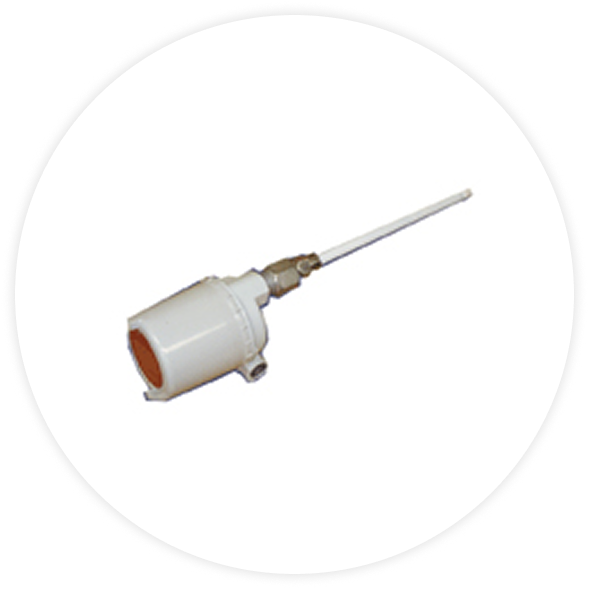
| When to Use a Switch (Captrol) | When to Use a Transmitter (Cap-Analog) |
|---|---|
|
For on/off level detection such as high/low alarms or pump start/stop. |
For continuous level measurement or inventory tracking. |
|
When simplicity, low cost, or redundancy are priorities. |
When process visibility, trending, or automation are required. |
|
Ideal for overfill protection, batch control, or interface detection. |
Ideal for tank monitoring, process feedback loops, and analog control systems. |
|
Used as backup safety interlocks alongside transmitters. |
Used as primary process measurement devices. |
Many systems employ both: a Cap-Analog transmitter for measurement, and Captrol switches for independent safety verification.
Global custody-transfer standards such as OIML R85, API MPMS and ISO 4266 emphasize continuous verification, traceability, and control of total measurement uncertainty. To meet these expectations in real-world tank environments, most operators rely on dual, independent level measurements to validate accuracy and detect drift before it impacts fiscal volumes.
API MPMS and OIML methodologies for calculating corrected volumes are built on the principle of cross-checking level, reference height, and tank calibration data. Dual level technologies reinforce this requirement by providing continuous verification and reducing uncertainty at every custody point.
In practice, the accuracy and verification framework defined by OIML, ISO 4266, and API MPMS is best satisfied by a redundant level-measurement architecture—one instrument serving as the primary custody device, and a second providing the independent confirmation needed for auditability, traceability, and long-term measurement confidence.
| Technology | Primary Role | How Capacitance Complements It (Cap-Analog vs Captrol) |
|---|---|---|
|
Radar Level Gauges (EVO 1610 / EVO 2600 / MCG 1600SFI) |
High-accuracy continuous level measurement; API 2350 tank overfill architectures |
Cap-Analog: Provides a cost-effective continuous level reference for non-custody tanks or non-critical vessels where radar may be overkill. Captrol: Adds independent high/low alarms and pump/shutdown protection as a second or third layer of protection alongside radar. |
|
Microwave Point Switches (Microwave 320) |
Non-contact point detection for solids, powders, pellets, or blockages |
Cap-Analog: Not typically used with microwave point detectors. Captrol: Provides contact-based verification in dusty or variable-bulk-density applications; serves as secondary or redundant high-level protection if microwave is primary. |
|
Magnetostrictive Level Transmitters (8150B / 8151 / 1010M) |
Continuous, precise liquid level and interface measurement (inventory, day tanks) |
Cap-Analog: Complements magnetostrictive by offering continuous measurement in vessels with coatings, viscous liquids, or materials not suitable for floats. Captrol: Adds solid-state point-level alarms or pump control so the magnetostrictive unit focuses on continuous measurement while Captrol handles safety/shutdown. |
|
Servo Level Gauges (MCG 1500SFI) |
High-precision custody-transfer level, density & interface |
Cap-Analog: Used on ancillary tanks or non-custody tanks where servo is not required. Captrol: Provides independent overfill protection and API 2350 alarm layers—important because custody gauges are not relied upon for safety alarm functions. |
|
Float & Tape / Gauge Boards (MCG 2000 / 92021) |
Mechanical, no-power level reference; visual indication |
Cap-Analog: Offers a parallel electronic signal for remote monitoring where float & tape provides only local mechanical reading. |
|
Ultrasonic Point Level Switch (Sonac 110) |
Contact ultrasonic point-level switch for liquids; ideal where no moving parts and fast actuation is needed |
Cap-Analog: Provides continuous analog measurement to pair with Sonac 110’s discrete point detection. Captrol: Serves as alternative or redundant point-level technology in applications where coatings or dielectric changes may challenge ultrasonic switches—offering a second independent point. |
|
Magnetostrictive Point Level Switch for Bulk Solids (Sonac 220) |
Motion-based or position-based point switch for powders, pellets, and dry solids |
Cap-Analog: Can provide a continuous level trend for solids where Sonac 220 offers only ON/OFF detection. Captrol: Provides redundant contact verification or additional setpoints in materials where Sonac 220 responds to motion but a capacitance threshold provides more stable alarms. |
Best For: General process tanks, conductive or semi-conductive liquids, and viscous media.
Best For: Long-distance signal transmission and intrinsically safe installations.
Best For: Tanks requiring both analog control and discrete level alarms.
Best For: Operators needing local indication in addition to control outputs.
| Model | Probe Type | Maximum Length |
|---|---|---|
|
410 / 4100 |
Flexible Cable Probe |
Up to 250 ft (76.2 m) |
|
420 / 421 |
Remote Preamp Probe |
Up to 800 ft (243.8 m) cable separation |
|
All Models |
Rigid Rod Probe |
Up to 19 ft (5.8 m) rigid insertion |
Best For: High or low alarms in tanks and hoppers.
Best For: Chemical or petrochemical tanks where local access is restricted.
| Model | Probe Type | Maximum Probe / Cable Length |
|---|---|---|
|
Captrol 500 / 511 |
Rigid Probe |
Up to 19 ft (5.8 m) |
|
Captrol 510 / 514 |
Flexible Cable Probe |
Up to 250 ft (76.2 m) |
|
Captrol 520 |
Remote System Cable |
Up to 800 ft (243.8 m) separation |